
 Assistant

ENTP-AH
Collaborative Explorer
Proposes and tests new approaches early, checks feedback through conversation, and attends to partners’ feelings and participation.
A new question can be an invitation to try things together
When a discussion reaches a familiar conclusion, you may wonder: what would happen if we reversed one condition? You enjoy seeing partners pick up an idea, change it, and open paths you had not considered, rather than simply presenting your own view in full.
ENTP-AH, the “Collaborative Explorer,” tends to be willing to test a new direction early while caring whether others genuinely want to participate. Having ideas can be enjoyable; whether they help still needs to be checked against real problems and feedback.
The fun can lie in changing the question together, not just finding an answer
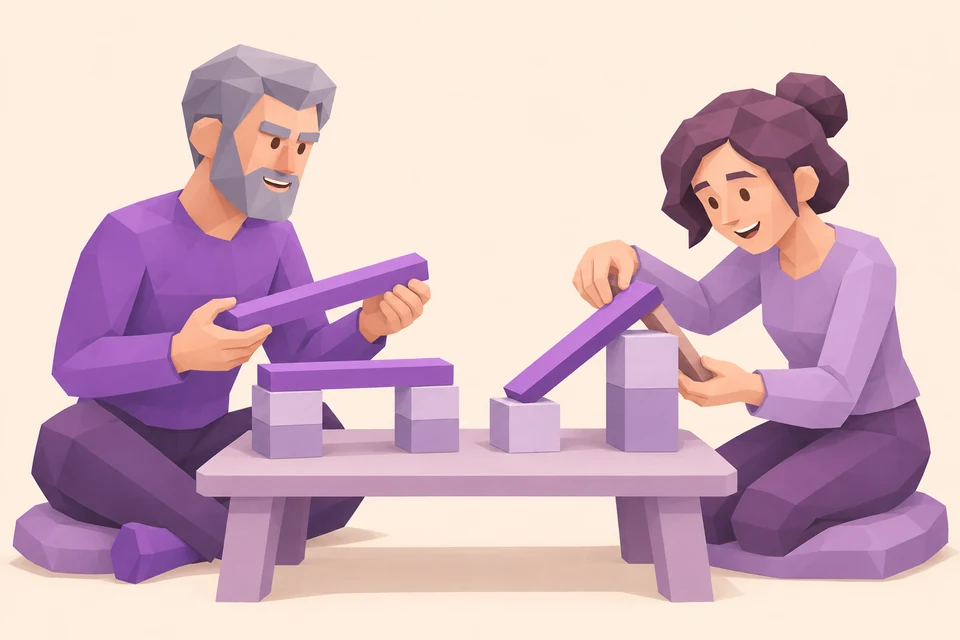
You might devise unusual solutions to an everyday problem with friends, change a rule in a familiar game, or choose alternative routes for an ordinary walk. Playful exploration can be satisfying in its own right; it does not all have to become an efficiency improvement.
Some people want to keep exploring, while others prefer the original way of playing. Ask what everyone wants from this round before deciding whether to run a small trial. Shared interests also mean allowing people not to join, rather than treating silence as agreement.
What do the ENTP basic type and AH suffix describe?
In Type64, ENTP describes developing ideas through interaction, noticing new connections and possibilities, testing views for logic and explanatory value, and keeping room to adjust external arrangements. Enjoying a different way of framing a problem does not mean always having to disagree with others.
ENTP-AH adds two angles for observation: A (Assertive) emphasizes getting started once there is enough information to support a next step, then adjusting through practical feedback; H (Harmonious) emphasizes feelings, mutual understanding, and shared participation. Attending to relationships does not require agreeing with every opinion.
T concerns logic and consistent criteria in judgment, while H/C concerns priorities in interaction. P concerns flexibility in external arrangements, while A/O concerns the steps leading into action. These conceptual distinctions do not establish statistical independence between the dimensions. For code definitions, see Type64's classification and personality codes.
Turn an alternative idea into a question you can test together
Imagine your group has been debating an activity’s schedule for a long time. You think of splitting consecutive stages into two alternative entry points, so you suggest walking through it on paper to see whether it would actually reduce waiting. Partners can point out what they do not accept or propose another change; they are not there simply to carry out your idea.
This can make an abstract disagreement more concrete, but a walkthrough cannot establish that the full event will work. Agree beforehand on what to observe, the maximum time to spend, and the conditions that must stay fixed. When a counterexample emerges, check whether it changes the assumption before keeping, narrowing, or dropping the plan.
Discussion can be interesting while someone else simply wants to be heard
When a friend describes an upsetting conversation, several explanations may come to mind, and you may want to reconstruct the other person’s reasons. Another possibility can sometimes help, but it may also make your friend feel that their situation is being debated before it has been heard. First reflect back the difficulty they have actually described, then ask whether they want to analyze it together.
You can still disagree, but “I’m just discussing it” is not a reason to ignore the impact. Explain which claim you are testing, rather than judging whether someone is intelligent or open-minded. If they do not want to continue, ending the discussion does not mean abandoning independent thought. Shared exploration requires both people to be willing.
ENTP-AH and neighboring combinations: change one dimension at a time
You and your friends are trying changes to the rules of a board game. The comparisons below keep the basic type and situation the same, changing only one suffix dimension at a time. They do not rank ability, how much someone cares, or the value of a personality.
| Types | The difference in the same situation |
|---|---|
| ENTP-AH and ENTP-OH | ENTP-AH: Proposes one round with new rules, inviting everyone to say what they enjoy and what they do not want to continue. ENTP-OH: First compares several changes and participants' concerns, then chooses a version everyone is willing to try. |
| ENTP-AH and ENTP-AC | ENTP-AH: Proposes one round with new rules, inviting everyone to say what they enjoy and what they do not want to continue. ENTP-AC: Tests one change within the agreed scope, making clear that this is only the current trial and does not decide on anyone else's behalf. |
Distinguish basic types before comparing suffixes
When comparing with ENFP, a T/F clue is whether you tend to start by checking the internal consistency of an idea or by considering values and its impact on people; enthusiasm does not distinguish them. When comparing with INTP, notice whether you more naturally develop ideas through discussion or work them through internally before sharing them. People with either preference may need both time alone and companionship.
The same code cannot sum up every experience. Read why people with the same personality type can differ to distinguish preferences, experience, and current responsibilities.
Turn a proactive response into something you can observe
When you next suggest an alternative, explain both “What are we testing this round?” and “What feedback would make me drop this idea?” Invite views that can genuinely change the arrangement, not just help build your idea. That is how personal excitement can become shared practice.
Frequently asked questions
Should AH mean always speaking up and maintaining the mood?
No. H concerns needs in interaction; it does not require you to keep things lively. Someone may need a pause, a direct disagreement, or time to think alone. Those needs deserve a response too. Allowing different ways to participate matters more than speaking continuously.
Why do people who are all ENTP-AH enjoy different activities?
A code describes tendencies, not a list of everyone’s interests. Experience, skills, culture, responsibilities, and energy all affect how preferences appear. Compare motivations, the steps before getting started, and needs in interaction; do not expect people with the same combination to do the same things.
Can letters from another website be converted directly into AH?
No. Even with the same basic code, tests may differ in questions, dimension definitions, scoring, and suffixes. Another site's A/T cannot replace Type64's A/O and H/C. Use the guide to comparing results across websites to compare each element.
This article explains the combination using Type64's current definitions. The situations and illustration are examples, not predictions about every individual or evidence of ability, career suitability, or relationship outcomes. Having 64 categories does not mean greater accuracy. For the scope of use and evidence boundaries, see the Type64 framework and its limitations.


