
 Assistant

INTP-OH
Reflective Connector
Willing to compare different explanations and the conditions in which they apply, while taking others’ differing questions and needs seriously.
An explanation also needs to fit the people and circumstances involved
A friend says that a study method you find effective has not helped them. Your first reaction may be curiosity: do you both mean the same thing by “learning”? How do your prior knowledge and practice conditions differ? The more specifically they describe their experience, the more your once-simple conclusion reveals aspects that need a fresh look.
The INTP-OH “Reflective Connector” combines a foundation of conceptual exploration, logical analysis, and openness to possibilities with O’s comparison before deciding and H’s attention to interpersonal interaction. You want to understand why an explanation holds, and you are willing to include people’s actual circumstances in that understanding.
You may enjoy a conversation that unfolds gradually: neither person rushes to prove they are right, each shares their reasoning, and differences that previously seemed puzzling begin to make sense. The question may not be resolved immediately, but you both have a clearer idea of what to ask next.
Understanding INTP, O, and H
In INTP, I favors sorting things out alone first, N focuses on connections and possibilities, T values logic and consistent criteria, and P tends to leave room for exploration and adjustment. O (Observant) focuses on comparing assumptions, conditions, and outcomes before deciding, while H (Harmonious) attends to feelings, needs, and the understanding and trust involved in cooperation.
In this combination, logical reasoning and concern for people’s circumstances can occur together. For example, even when a suggestion makes logical sense, you may still want to know whether the conditions for applying it are present and whether it addresses what troubles the other person most. Their unease alone does not mean the suggestion must be wrong.
For the full code definitions, see the Type64 classification and code guide. T/F concerns the basis for judgments, while H/C concerns this site’s focus in interpersonal interaction. Caring about others does not automatically imply F, and spending time alone does not automatically imply C.
Different perspectives open new paths to understanding
After watching the same film, a friend loves a particular character while you question that character’s choices. You may want to know which experiences matter to your friend and what assumptions shape your own view. Hearing an interpretation you had not noticed can give the story more depth.
This curiosity can also extend to learning together. One person wants to understand the concepts first; another wants to know how to use them. You may be willing to compare both paths and identify where each calls for different materials, rather than expecting everyone to follow your sequence.
Time alone can still be important for organizing your thoughts. After a discussion, you may need to read a few more pages or redraw a concept map. Once your thinking is clearer, you can tell your companions which parts of your view have changed, giving the conversation genuinely new material.
Compare conditions and listen to practical difficulties
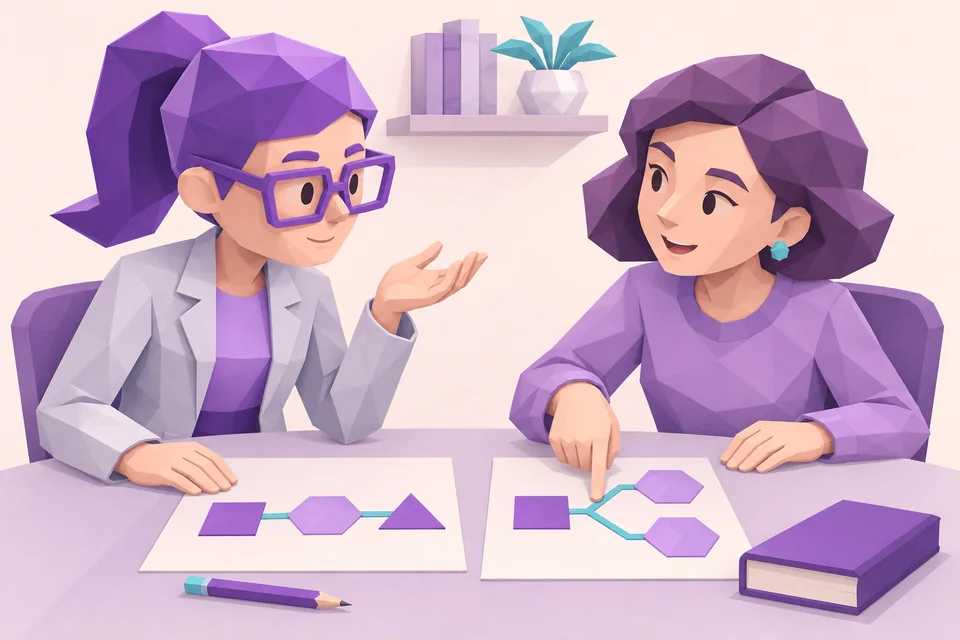
When preparing a knowledge-sharing session together, you may first outline several ways to explain the topic: which requires more background, which could lead to misunderstandings, and what problem the audience actually wants to solve. Your comparison considers not only the material but also what participants already know.
If a collaborator says the content is too difficult, start by asking exactly where they get stuck. An unexplained concept, an unfamiliar example, and too much material at once are different problems. Once you identify those differences, you can decide whether to add supporting material, change the example, or narrow the scope for this round.
Understanding things in advance cannot replace direct experience. You can first identify the conditions that could genuinely change your approach, then design a trial that allows for adjustment. Someone saying “I understand” does not necessarily mean you share the same understanding; asking them to give an example of their own can often provide useful information for the next discussion.
Explaining a reaction still requires asking the person
When someone close to you does not respond to your suggestion, you may think of many reasons: was it too complicated, are they reluctant to change, or have you overlooked some pressure they are under? Considering these possibilities can be useful, but they are not yet facts the other person has expressed.
Try turning your guesses into an open question: “I’m not sure whether that suggestion was helpful. Would you rather keep analyzing it, or first finish telling me what’s been happening lately?” Let their answer revise your understanding instead of deciding on their behalf which explanation is most reasonable.
Sometimes your disagreement deserves to be heard too. Maintaining trust does not require hiding differences. You can first explain what you understand, then identify the point you still cannot agree with. Two people do not have to reach the same conclusion to keep valuing their conversations.
Give preparation an endpoint, and do not confuse understanding with taking everything on
When every explanation raises new questions, and you also want to avoid a decision that puts others in a difficult position, a discussion may struggle to reach even a provisional choice. You understand the complexity more and more, yet still do not know which questions must be answered now.
Write down the specific evidence needed for the next step: what missing information could change the direction, who will verify it, and when you will reconvene to compare results. Low-cost, reversible decisions can be explored through a trial; long-term commitments still warrant the necessary comparison beforehand.
Also ask yourself: is there some responsibility here that I do not need to carry? You can carefully consider others’ concerns while explaining what help you are willing to offer. Reassuring everyone should not become a task you must complete alone.
OH compared with AH and OC: what comes after understanding?
The comparisons below keep the INTP foundation the same while examining O/A and H/C separately. Complex problems are not exclusive to O, nor are close relationships exclusive to H. What matters is noticing recurring patterns of attention.
After reading, you could record a shared decision in which new conditions changed your view, then note a small matter you could decide without extensive discussion. Comparing familiarity, costs, and practical needs is more useful than treating every act of verification as a personality trait. The guide to reading your report offers a way to record descriptions separately from lived experiences.
| Comparison | Understanding the types in the same situation |
|---|---|
| INTP-OH vs INTP-AH | A group wants to know whether a particular learning arrangement suits them. OH may first compare everyone’s starting points, goals, and difficulties with understanding, then agree on a trial. AH may first choose a short exercise everyone can join and adjust the explanation based on their actual responses. Both can listen, and both need to check key conditions. |
| INTP-OH vs INTP-OC | A friend invites you to make a long-term commitment to a discussion project based on a shared interest. OH may first seek to understand what everyone wants to discuss and what concerns them, then compare possible shared arrangements. OC may first check the topic’s underlying assumptions, their own involvement, and the scope of the commitment. Both can respond thoughtfully, and both can decline unsuitable requests. |
Frequently asked questions
O and P both leave possibilities open. Do they mean the same thing?
P concerns openness and adjustment when dealing with external arrangements. O concerns how you compare conditions, risks, and outcomes before deciding. You can keep several approaches open while checking key assumptions before starting. This is a distinction between definitions, not proof of statistical independence; see the framework and its limits of use.
Sometimes I decide quickly or have little patience for listening. Can OH still fit me?
First record the specific experiences that do not fit, then compare the time, energy, familiarity, and responsibilities involved. A suffix cannot describe every situation, and people with the same combination can differ. See how to observe differences within the same type.
Can OH, O, or INTP-T results from other websites be converted into this system?
Similar wording or letters alone are not enough to infer an equivalent result. Keep the site name, full code, and original explanation, then use the guide to comparing results across websites to check sources and definitions. Do not convert results without a supporting basis.
About this type introduction
This article follows Type64’s current definitions. The everyday scenarios and illustration are explanatory examples, not records of actual test-takers or questions used to determine a type. Type descriptions support self-observation; they do not measure intelligence, professional competence, or mental health. Having more categories does not itself make a system more accurate.
[1] Myers & Briggs Foundation: the four preference pairs; the 16 foundational types. These resources support only the concepts of the foundational preferences; they do not validate Type64’s AOHC.
Continue to browse the 64 personality types.


