
 Assistant

INFP-OH
Gentle Explorer
Compares choices and their effects around valued principles, then responds to others with understanding and support after careful consideration.
Make room for what matters in arrangements both people want
When a friend proposes a meaningful plan, you may first imagine what it could bring everyone, then gradually ask how each person wants to take part. You enjoy understanding the care behind a choice and hope the practical arrangements will not turn a good idea into a burden.
INFP-OH, “Gentle Explorer,” attends to values, comparison of conditions before action, and responses within relationships. Being gentle does not mean having no opinion, and exploring does not require keeping every option forever. Your position should also enter the shared decision.
Interests gain different meanings through conversation
You may enjoy discussing a work with people you know: one person is moved by a goodbye, another by a character finally learning to refuse. Rather than choose the correct interpretation immediately, you discover through different experiences how many meanings the work can hold.
Before joining a course or making something together, you want to compare the content and pace and know whether your partner is genuinely interested. Hesitation is worth asking about, but you need not supply a plan that satisfies everyone. Sometimes choosing separately and talking afterward is still a good connection.
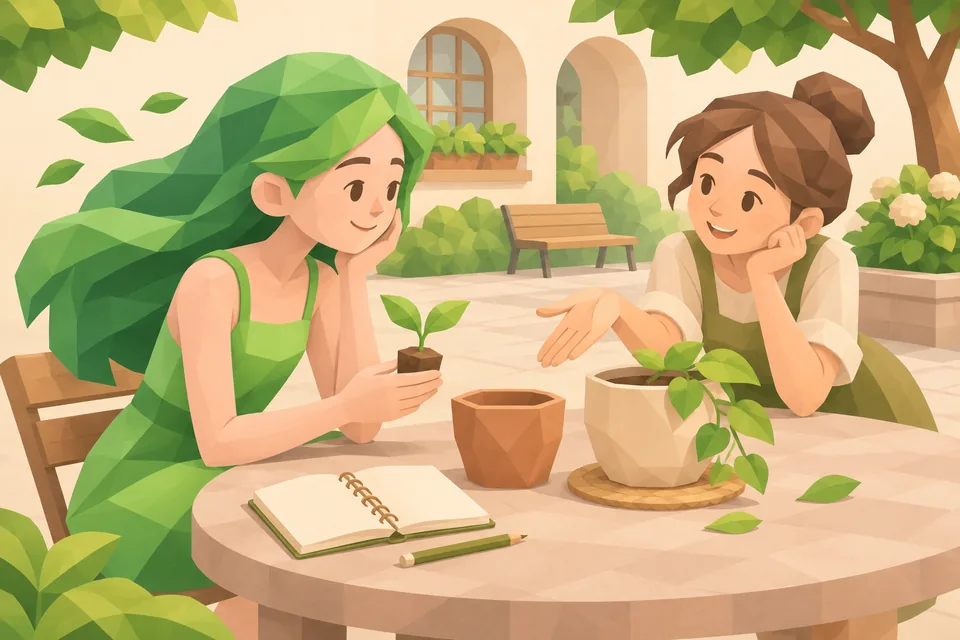
What the INFP foundation and OH suffix each describe
In Type64, INFP brings together inward reflection, attention to connections and possibilities, judgments informed by values and their impact on people, and flexibility in external arrangements. It helps explain why you care whether something feels true to you. The suffix adds observations about when you begin and how you relate to others.
INFP-OH adds two further angles of observation: O (Observant) focuses on comparing conditions, risks, and later effects before choosing a course of action; H (Harmonious) focuses on feelings, understanding, and shared participation. Caring about a relationship does not require agreeing with every opinion.
F concerns values and human impact in judgment; H/C concerns attention within interactions. P concerns room to adjust external arrangements, while A/O concerns the sequence of processing before action. These are conceptual distinctions, not proof of statistical independence between dimensions. For the code meanings, see the guide to Type64 classification and codes.
Support someone by understanding what they actually need
If a friend wants to end a collaboration immediately after an argument, you may neither urge reconciliation nor agree straight away. You first ask what happened, what hurt them most, and whether the arrangement could change. After understanding the situation, you might help them find words or prepare a conversation.
A possible strength is that support can connect emotional reassurance to concrete problems and next steps. Yet understanding both sides does not require taking responsibility for mediation. Caring about the relational atmosphere does not mean managing everyone’s feelings.
First check: “Would you like me to listen, or think through options with you?” If help is wanted, clarify the time and scope. Understanding someone still leaves room to decline an unsuitable request. Warmth and boundaries do not conflict.
Turn an ideal into a plan others can take part in
In a group assignment or team project, you may notice when an efficient proposal leaves some members without a chance to speak. You may first clarify the value the project aims to realize, then learn about members’ concerns and seek an arrangement that serves both the goal and participation.
This can uncover overlooked needs and reduce surface agreement without real involvement. A limitation is that trying to keep everyone’s ideas can make the plan expand indefinitely. You might also mistake discomfort in discussion for proof that the plan itself is wrong.
Before discussion, clarify the necessary outcome, firm constraints, and adjustable parts. Invite concerns and agree on a decision time. Giving everyone a chance to speak does not mean every suggestion must be adopted.
INFP-OH and neighboring combinations: change one angle at a time
A friend invites you to help care for a small community garden. The comparisons below keep the same base type and situation, changing just one suffix dimension at a time. They do not rank ability, depth of care, or personality.
| Types | Different priorities in the same situation |
|---|---|
| INFP-OH and INFP-AH | INFP-OH: Compare sunlight, scheduled care shifts, and participants’ expectations, then agree on an arrangement everyone is willing to try. INFP-AH: Once the site and timing are workable, arrange a first planting session and ask what partners want to grow and how they would feel comfortable taking part. |
| INFP-OH and INFP-OC | INFP-OH: Compare sunlight, scheduled care shifts, and participants’ expectations, then agree on an arrangement everyone is willing to try. INFP-OC: Independently check the ongoing upkeep and your genuine willingness, establish a limited responsibility, then decide which part to take on. |
Read base-type differences separately from the suffix
Observe the J/P difference between INFP and INFJ in personal plans: do you more naturally keep several paths open or settle on a plan for the next stage? For the N/S difference with ISFP, consider whether you first explore an experience’s meaning and other possibilities or return to concrete experiences, materials, and details of the moment. Both can care about people, plan, or create; artistic interests do not distinguish the types.
Give comparison and understanding a clear endpoint
Divide a shared choice that remains unresolved into three columns: what I really want, what the other person explicitly said, and what I am guessing for them. Check the third column first, set a deadline for clarifying essential conditions, then decide on a trial or separate arrangements. Understanding can help a choice without extending it indefinitely.
Frequently asked questions
If I keep thinking of everyone, should OH put me last?
No. H describes attention to feelings and understanding, not an order of self-sacrifice. Stating your time, interests, and what you will not take on lets both people test whether they genuinely accept the arrangement. Temporary disappointment does not necessarily mean the relationship is damaged.
Can one careful, considerate act establish OH?
No. A single act may reflect risk, duties, or politeness. Look across ordinary situations at what you naturally check first and how you confirm the other person’s needs. Keep opposite examples too; one performance cannot establish a type.
Are 64 categories more accurate than the 16 base types?
More categories do not automatically make a measure more accurate. Suffixes add angles of observation; evidence for measurement requires separate research and validation. For the scope of use, see the Type64 framework and its limits.
This article explains the combination using Type64’s current definitions. The situations and illustrations are explanatory, not predictions about every individual or evidence of ability, career fit, or relationship outcomes. Having 64 categories does not mean greater accuracy. For the scope of use and available basis, see the framework guide.


